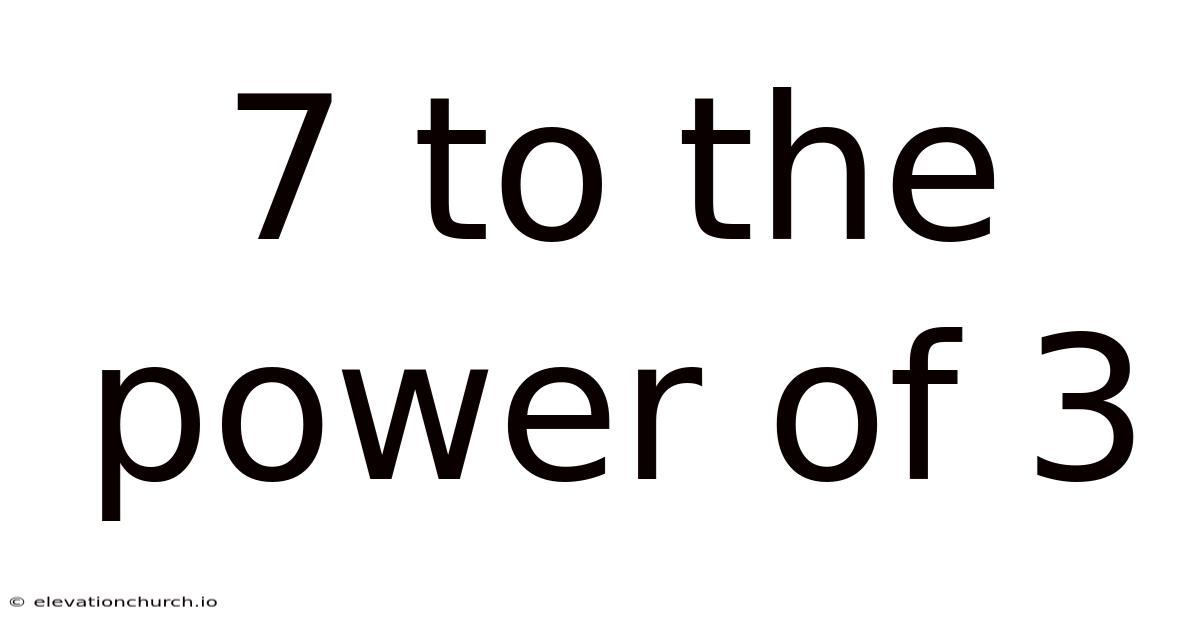
7 to the power of 3, often written as 7³ or read aloud as “seven cubed,” is a fundamental example of exponential notation that appears in basic arithmetic, algebra, geometry, and even real‑world problem solving. Understanding how to compute and interpret this expression builds a solid foundation for more advanced topics such as polynomial functions, volume calculations, and scientific notation. In this article we explore what 7³ means, how to calculate it step by step, the mathematical properties that surround it, practical applications where the value 343 shows up, and some interesting tidbits that make the concept memorable Small thing, real impact..
Honestly, this part trips people up more than it should.
What Does “7 to the Power of 3” Mean?
At its core, an expression like 7³ tells us to multiply the base number (7) by itself a number of times equal to the exponent (3). The exponent is sometimes called the power or index. In formal notation:
[ 7^{3} = \underbrace{7 \times 7 \times 7}_{\text{three factors of 7}} ]
- Base: the number being multiplied (here, 7).
- Exponent (or power): the small superscript number indicating how many times the base appears as a factor (here, 3).
- Result: the product obtained after carrying out the multiplication, known as the value of the power.
When the exponent is 3, we often refer to the result as the cube of the base because it corresponds to the volume of a cube whose side length equals the base. Thus, 7³ is also called “seven cubed.”
Step‑by‑Step Calculation of 7³
Although calculators can give the answer instantly, working through the multiplication manually reinforces the concept of repeated multiplication and helps catch errors. Below is a clear, numbered procedure:
-
Write out the factors
[ 7^{3} = 7 \times 7 \times 7 ] -
Multiply the first two factors
[ 7 \times 7 = 49 ] -
Multiply the interim product by the remaining factor
[ 49 \times 7 = 343 ] -
State the final result
[ 7^{3} = 343 ]
Tip: If you prefer to think in terms of addition, you can view each multiplication as adding the base repeatedly:
(7 \times 7 = 7+7+7+7+7+7+7 = 49), then (49 \times 7) means adding 49 seven times, which also yields 343 It's one of those things that adds up. Worth knowing..
Mathematical Properties and Patterns Involving 7³
Understanding the broader context of 7³ reveals why the number 343 appears in various mathematical settings.
1. Relationship to Perfect Cubes
A perfect cube is an integer that can be expressed as (n^{3}) for some whole number (n). The sequence of perfect cubes begins:
[ 1^{3}=1,; 2^{3}=8,; 3^{3}=27,; 4^{3}=64,; 5^{3}=125,; 6^{3}=216,; 7^{3}=343,; 8^{3}=512,\dots ]
Thus, 343 is the seventh perfect cube. Recognizing where a number falls in this list helps with estimation and mental math.
2. Digital Root and Divisibility
- Digital root: Repeatedly summing the digits of 343 (3+4+3 = 10, then 1+0 = 1) gives a digital root of 1.
- Divisibility by 7: Since 343 = 7 × 49, it is obviously divisible by 7. Worth adding, 49 itself is 7², so 343 = 7 × 7² = 7³, confirming the exponent structure.
3. Modular Arithmetic
In modulo 7 arithmetic, any power of 7 is congruent to 0:
[ 7^{3} \equiv 0 \pmod{7} ]
This property is useful in cryptography and computer science when working with large numbers.
4. Connection to Triangular Numbers
Interestingly, the sum of the first seven odd numbers equals 7², and the sum of the first seven cubes equals the square of the sum of the first seven natural numbers:
[ 1^{3}+2^{3}+3^{3}+4^{3}+5^{3}+6^{3}+7^{3} = (1+2+3+4+5+6+7)^{2} = 28^{2}=784 ]
While 343 alone does not directly appear in that identity, it contributes to the overall pattern Less friction, more output..
Real‑World Applications of 7³ (= 343)
Exponential growth and cubic measurements show up in many practical contexts. Below are several domains where the value 343 is relevant Most people skip this — try not to..
Geometry and Volume
- Cube volume: A cube with side length 7 units (centimeters, meters, etc.) has a volume of (7^{3}=343) cubic units.
- Packing problems: If you need to fill a larger cube of side 14 units with smaller cubes of side 7 units, you would need ((14/7)^{3}=2^{3}=8) of the smaller cubes, each contributing 343 volume units for a total of (8 \times 343 = 2744) cubic units.
Physics and Engineering
- Fluid dynamics: The Reynolds number for flow in a cylindrical pipe sometimes involves cubic scaling of characteristic lengths; a length scale of 7 mm leads to a factor of 343 when comparing dimensionless groups.
- Structural load: In certain beam‑deflection formulas, the load capacity scales with the cube of the thickness; a beam 7 mm thick would have a load factor proportional to 343.
Computer Science
- Memory addressing: Some early computer architectures used 7‑bit address fields, allowing (2^{7}=128) addresses. While not directly 7³, the concept of raising a small base to a small exponent appears in calculating possible states (e.g., a 3‑digit base‑7 number has (7^{3}=343) distinct combinations).
- Hash tables: When designing a hash table with a prime size close to a
