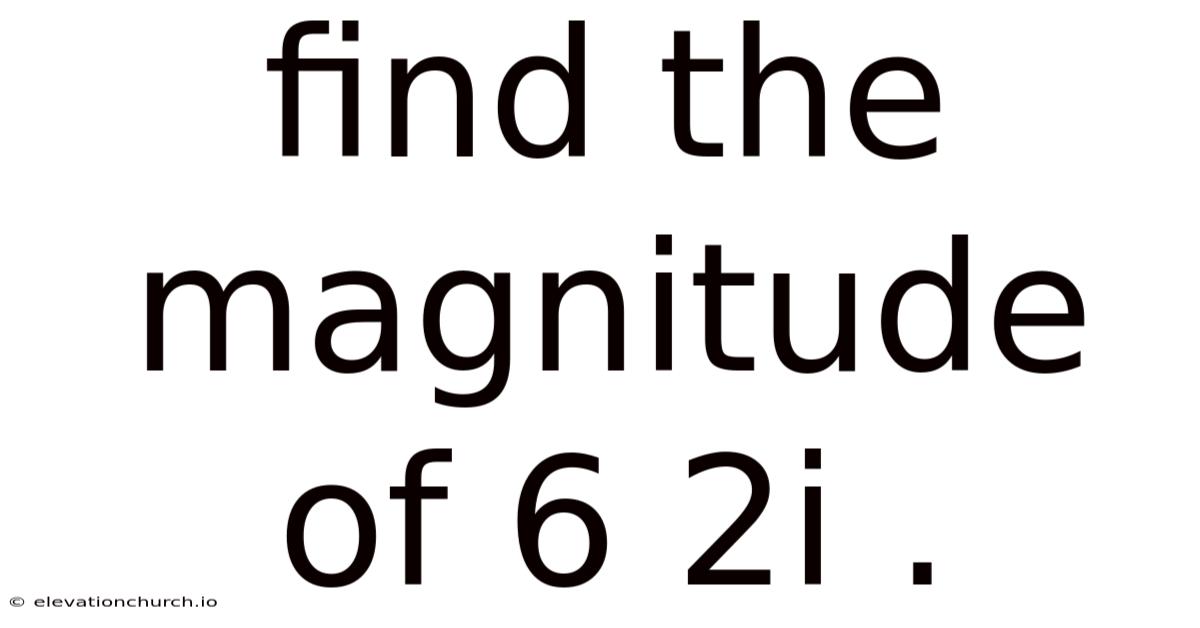
Find the Magnitude of 6 + 2i
Complex numbers form a fundamental part of modern mathematics, engineering, and physics. While they extend the real number line into a two-dimensional plane, they retain elegant properties that make calculations both intuitive and powerful. One of the most essential properties of any complex number is its magnitude—also called its modulus. Understanding how to compute this value opens the door to deeper topics such as complex analysis, signal processing, and quantum mechanics. In this article, we’ll explore the concept of magnitude, walk through the exact steps to find the magnitude of (6 + 2i), and examine why this calculation matters beyond the classroom.
Short version: it depends. Long version — keep reading.
The Concept of Magnitude in Complex Numbers
Every complex number can be written in the form (z = a + bi), where (a) and (b) are real numbers, and (i) is the imaginary unit defined by (i^2 = -1). The complex plane, also known as the Argand plane, represents such a number as a point with coordinates ((a, b)), where (a) is the horizontal (real) component and (b) is the vertical (imaginary) component It's one of those things that adds up..
The magnitude of a complex number, denoted (|z|), measures the distance of that point from the origin ((0, 0)). Because distance in a plane is calculated using the Pythagorean theorem, the magnitude is always a non-negative real number. This geometric interpretation is not just a visual aid—it’s the mathematical foundation for the formula we use to compute (|z|) algebraically And that's really what it comes down to..
For any complex number (z = a + bi), the magnitude is defined as:
[ |z| = \sqrt{a^2 + b^2} ]
This formula arises directly from the distance formula in two-dimensional Cartesian coordinates. When we square the real part (a), square the imaginary part (b), add them together, and take the square root, we obtain the straight-line distance from the origin to the point ((a, b)). This holds true regardless of which quadrant the complex number resides in, because squaring eliminates any sign differences.
Step-by-Step: Finding the Magnitude of 6 + 2i
Let’s apply the general formula to the specific complex number (6 + 2i). Here, the real part (a = 6) and the imaginary part (b = 2). Substituting these values into the magnitude formula gives:
[ |6 + 2i| = \sqrt{6^2 + 2^2} ]
Now, compute the squares:
[ 6^2 = 36, \quad 2^2 = 4 ]
Add the results:
[ 36 + 4 = 40 ]
Take the square root:
[ \sqrt{40} = \sqrt{4 \times 10} = \sqrt{4} \times \sqrt{10} = 2\sqrt{10} ]
Thus, the exact magnitude of (6 + 2i) is (2\sqrt{10}). If a decimal approximation is desired, (\sqrt{10} \approx 3.1623), so:
[ 2\sqrt{10} \approx 2 \times 3.1623 = 6.3246 ]
The magnitude is approximately (6.32). This value represents the distance from the origin to the point ((6, 2)) on the complex plane.
The Formula Explained in Depth
Why does (\sqrt{a^2 + b^2}) give us the magnitude? The reasoning connects algebra to geometry in
The reasoning connects algebra to geometry in the complex plane, where the magnitude corresponds to the Euclidean distance from the origin. This leads to when we plot a complex number (z = a + bi) as a point ((a, b)), the real part (a) and imaginary part (b) form the legs of a right triangle with the hypotenuse representing the line from the origin to the point. That's why thus, (|z| = \sqrt{a^2 + b^2}) directly calculates this hypotenuse, providing a measure of the number's size or amplitude, independent of its direction. Think about it: this distance is derived from the Pythagorean theorem, which states that in a right-angled triangle, the square of the hypotenuse is equal to the sum of the squares of the other two sides. This geometric interpretation is fundamental because it allows us to treat complex numbers as vectors, facilitating operations like addition, subtraction, and multiplication in a visually intuitive way.
Beyond the classroom, the concept of magnitude is crucial in various fields. In signal processing, for example, the magnitude of a complex number represents the amplitude of a signal, which is essential for analyzing sound waves, radio frequencies, or electrical circuits. Because of that, in quantum mechanics, complex numbers describe wave functions, and their magnitudes relate to probabilities, such as the likelihood of finding a particle in a particular state. Still, additionally, in engineering and physics, magnitude calculations are used to compute forces, voltages, and impedances in AC circuits, where complex numbers simplify the analysis of oscillatory systems. Understanding how to find the magnitude, as with (6 + 2i), builds a foundation for more advanced topics like complex analysis, control theory, and even computer graphics, where vectors and transformations rely on similar principles.
To wrap this up, mastering the calculation of a complex number's magnitude is more than a mathematical exercise; it is a gateway to understanding the geometry of the complex plane and its applications across science and technology. By grasping that (|6 + 2i| = 2\sqrt{10}), we see not just a number, but a distance that embodies the interplay between algebra and geometry. This knowledge equips us to tackle real-world problems, from designing communication systems to exploring quantum phenomena, highlighting the enduring relevance of complex numbers in modern innovation.
Honestly, this part trips people up more than it should.
Step-by-Step Calculation: The Case of (6 + 2i)
While the formula (\sqrt{a^2 + b^2}) is straightforward, walking through a specific example like (z = 6 + 2i) solidifies the mechanics and highlights common algebraic simplifications.
- Identify the components: Here, the real part (a = 6) and the imaginary part (b = 2).
- Substitute into the formula: [ |6 + 2i| = \sqrt{6^2 + 2^2} ]
- Square the components: [ = \sqrt{36 + 4} ]
- Sum the squares: [ = \sqrt{40} ]
- Simplify the radical: Since (40 = 4 \times 10) and (\sqrt{4} = 2), we extract the perfect square: [ = \sqrt{4 \times 10} = 2\sqrt{10} ]
- Decimal approximation (optional): For practical engineering contexts, (2\sqrt{10} \approx 6.325).
This process reveals that the magnitude is not merely an abstract formula but a concrete scalar value representing the "length" of the vector. Note that the magnitude is always a non-negative real number, stripping away the directional information (the argument) to leave only the scale.
Key Properties: Why Magnitude Behaves the Way It Does
The utility of magnitude extends far beyond single calculations; its algebraic properties make it a powerful tool for manipulating complex expressions without converting to rectangular coordinates constantly Which is the point..
- Multiplicative Property: For any two complex numbers (z_1) and (z_2), (|z_1 z_2| = |z_1| |z_2|). Geometrically, multiplying complex numbers rotates and scales vectors; this property confirms that the scaling factors multiply while the rotations add. This is the algebraic backbone of why polar form ((r e^{i\theta})) is so efficient for multiplication and division.
- Quotient Property: Similarly, (|z_1 / z_2| = |z_1| / |z_2|) (provided (z_2 \neq 0)).
- Power Property: By induction, (|z^n| = |z|^n) for any integer (n). This allows for the immediate calculation of magnitudes for high powers or roots without binomial expansion.
- Triangle Inequality: (|z_1 + z_2| \le |z_1| + |z_2|). This mirrors the geometric fact that the length of one side of a triangle is never greater than the sum of the lengths of the other two sides. It provides essential bounds in complex analysis and stability proofs in control theory.
- Conjugate Symmetry: (|z| = |\bar{z}|) and (z \bar{z} = |z|^2). This identity is the standard method for rationalizing denominators (e.g., (\frac{1}{a+bi} = \frac{a-bi}{a^2+b^2})) and defines the Euclidean metric in the complex plane.
A Final Perspective
The journey from the Pythagorean theorem to the magnitude of (6 + 2i) traces the evolution of mathematics from static geometry to dynamic analysis. We began with a right triangle on a plane, moved through the algebra of radicals and the physics of signal amplitudes, and arrived at the structural properties that underpin modern control systems and quantum field theory.
The magnitude (|z|) is the bridge between the algebraic definition of a complex number
The magnitude (|z|) is the bridge between the algebraic definition of a complex number and its geometric interpretation. This interplay allows us to treat complex numbers not merely as symbolic entities, but as objects with tangible size and direction, enabling a unified approach to problems in mathematics and science.
In essence, the magnitude of a complex number is far more than a mere computational tool; it is a conceptual linchpin that bridges algebra and geometry, symbolism and visualization, abstraction and application. By stripping away direction to reveal scale, it provides the scalar foundation upon which the richer structure of complex analysis is built. As mathematics continues to evolve and permeate the natural and engineered world, the seemingly simple notion of "length" in the complex plane remains a testament to the elegance and utility of mathematical thought, reminding us that the most profound insights often arise from the simplest of measurements Most people skip this — try not to..
