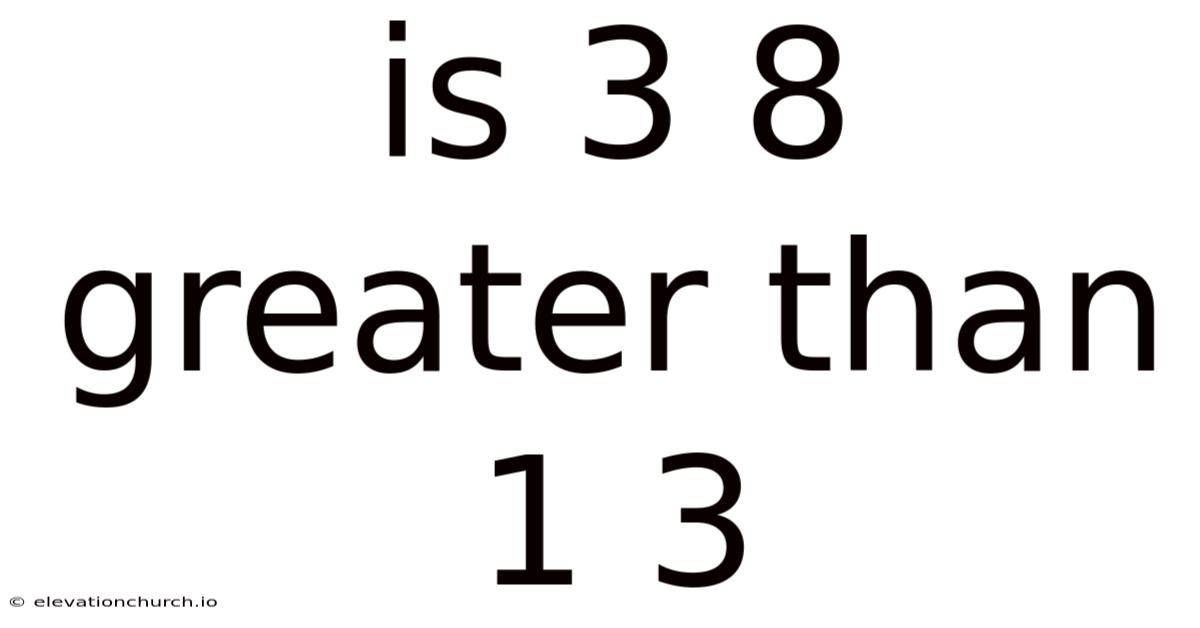
Is 3/8 Greater Than 1/3? A Detailed Guide to Comparing Fractions
When you encounter the question “is 3/8 greater than 1/3?” it’s natural to pause and think about how fractions relate to each other. Understanding fraction comparison is a fundamental skill that appears in everyday situations—from cooking recipes to budgeting—and it forms the basis for more advanced mathematical concepts. In practice, in this article, we will break down exactly how to determine whether 3/8 is larger than 1/3, explore the reasoning behind each method, and answer common questions that learners often encounter. By the end, you’ll have a clear, step‑by‑step framework you can use to compare any two fractions confidently.
Not the most exciting part, but easily the most useful.
Introduction
The core question—is 3/8 greater than 1/3—can be answered with a simple “no,” but the journey to that answer reveals a wealth of mathematical strategies. Whether you’re a student grappling with homework, a teacher preparing a lesson, or someone who just wants to sharpen your numerical intuition, mastering fraction comparison will pay dividends. Plus, fractions represent parts of a whole, and comparing them requires a common reference point. In this guide we’ll examine the most reliable techniques: converting to decimals, using cross‑multiplication, finding a common denominator, and even visualizing the fractions on a number line. Each method is explained with clear examples, so you can choose the one that feels most natural for your learning style Practical, not theoretical..
People argue about this. Here's where I land on it.
Why Fraction Comparison Matters
Before diving into the mechanics, it’s helpful to understand why we compare fractions at all. Fractions are used to express:
- Proportions (e.g., 3/8 of a pizza is left)
- Probabilities (e.g., a 1/3 chance of rain)
- Ratios (e.g., a 3:8 ratio of boys to girls)
Being able to tell which fraction is larger helps you make informed decisions, whether you’re splitting a bill, adjusting a recipe, or analyzing data. The ability to compare fractions also lays the groundwork for operations like addition, subtraction, and later, algebraic manipulations.
Method 1: Convert to Decimals
Probably most straightforward ways to compare fractions is to turn them into decimal form. Decimals give you a direct numeric value that you can compare using standard inequality symbols.
Steps
-
Divide the numerator by the denominator for each fraction.
- For 3/8: 3 ÷ 8 = 0.375
- For 1/3: 1 ÷ 3 ≈ 0.333… (repeating)
-
Compare the decimal values And it works..
- 0.375 > 0.333…
-
Conclusion: Since 0.375 is larger than 0.333…, 3/8 is greater than 1/3.
When to Use This Method
- When you have a calculator or are comfortable with long division.
- When the fractions have denominators that are powers of 2 or 5 (making the decimal terminating).
Limitations
- Some fractions produce repeating decimals (like 1/3), which can be cumbersome to compare precisely without rounding.
- Relying solely on decimal conversion may obscure the underlying relationship between the fractions.
Method 2: Cross‑Multiplication
Cross‑multiplication is a powerful technique that avoids converting to decimals and works directly with the original numerators and denominators.
Steps
-
Set up the comparison: 3/8 ? 1/3
-
Cross‑multiply: Multiply the numerator of the first fraction by the denominator of the second, and vice versa Surprisingly effective..
- 3 × 3 = 9
- 1 × 8 = 8
-
Compare the products:
- Since 9 > 8, the fraction on the left (3/8) is larger.
Why It Works
Cross‑multiplication essentially creates a common denominator without explicitly writing it down. By comparing 3/8 and 1/3, we are implicitly comparing 3×3/24 and 1×8/24. The larger numerator indicates the larger fraction That alone is useful..
When to Use This Method
- When you need a quick mental check.
- When dealing with fractions that have relatively small denominators.
Common Pitfalls
- Forgetting to multiply the correct pairs (numerator of first with denominator of second, and numerator of second with denominator of first).
- Misapplying the method when one denominator is negative (not typical in basic fraction comparison).
Method 3: Find a Common Denominator
Finding the least common denominator (LCD) allows you to rewrite both fractions with the same denominator, making the comparison as simple as looking at the numerators.
Steps
-
Identify the denominators: 8 and 3.
-
Determine the least common multiple (LCM) of 8 and 3.
- Prime factors: 8 = 2³, 3 = 3¹.
- LCM = 2³ × 3 = 24.
-
Convert each fraction to an equivalent fraction with denominator 24 Easy to understand, harder to ignore..
- 3/8 = (3 × 3) / (8 × 3) = 9/24
- 1/3 = (1 × 8) / (3 × 8) = 8/24
-
Compare the numerators: 9 > 8, so 3/8 > 1/3.
When to Use This Method
- When you want to keep everything in fractional form, perhaps for further operations like addition or subtraction.
- When the denominators are not too large, making the LCM easy to compute.
Tips for Finding the LCD
- Write out the prime factorization of each denominator.
- Multiply each prime factor the greatest number of times it appears in any denominator.
- If one denominator divides the other (e.g., 4 and 12), the larger denominator is the LCD.
Method 4: Visual Representation on a Number Line
A visual approach can cement your understanding, especially for learners who benefit from spatial reasoning.
Steps
-
Draw a number line from 0 to 1 Not complicated — just consistent..
-
Mark the fractions:
- Divide the segment into 8 equal parts for 3/8; locate the third mark.
- Divide the same segment into 3 equal parts for 1/3; locate the first mark.
-
Observe the positions: The mark for 3/8 lies to the right of the mark for 1/3, indicating that 3/8 is larger Not complicated — just consistent..
When to Use This Method
- When teaching younger students or introducing the concept for the first time.
- When you need a quick, intuitive check.
Limitations
- Not practical for fractions with large denominators.
- Requires careful drawing to maintain proportional accuracy.
Scientific Explanation: Why the Comparison Works
From a mathematical standpoint, fractions are ratios of two
Scientific Explanation: Why the Comparison Works
From a mathematical standpoint, fractions are ratios of two numbers, where the numerator represents a part of the denominator. When comparing fractions, we are determining which ratio is larger. This is possible because all the methods rely on the fundamental properties of equality and inequality. Take this: cross-multiplication works because multiplying both sides by the denominators (assuming they are positive) preserves the inequality’s direction. Similarly, finding a common denominator allows direct comparison of numerators, as the denominators become identical, neutralizing their influence. The number line method visually demonstrates this by mapping fractions to their proportional positions, making their relative sizes intuitive. These approaches are grounded in the principles of scaling, equivalence, and proportionality, ensuring that comparisons remain valid regardless of the method chosen.
Conclusion
Comparing fractions is a foundational skill in mathematics, essential for problem-solving in algebra, geometry, and everyday applications. The four methods—cross-multiplication, common denominators, decimal conversion, and number line visualization—offer flexibility depending on the context, numbers involved, or learner’s preference. Cross-multiplication is quick for mental checks, while common denominators excel in scenarios requiring further operations. Visual tools like the number line provide clarity for conceptual understanding, and decimal conversion bridges fractions with real-world measurements Most people skip this — try not to..
Still, mastering these techniques requires practice. Each method has its strengths and limitations, and recognizing when to apply them prevents common pitfalls. By internalizing the "why" behind these methods—rooted in mathematical principles of equivalence and proportionality—you gain not just the ability to compare fractions, but also the confidence
to manipulate numbers with confidence. Whether you are a student building a mathematical foundation, a teacher conveying these concepts, or an individual applying these skills in daily life, the ability to compare fractions accurately is a testament to a deeper numerical literacy. Remember, the goal is not merely to find an answer, but to understand the relationships between numbers—a skill that will serve you well beyond the realm of fractions.
It sounds simple, but the gap is usually here.
