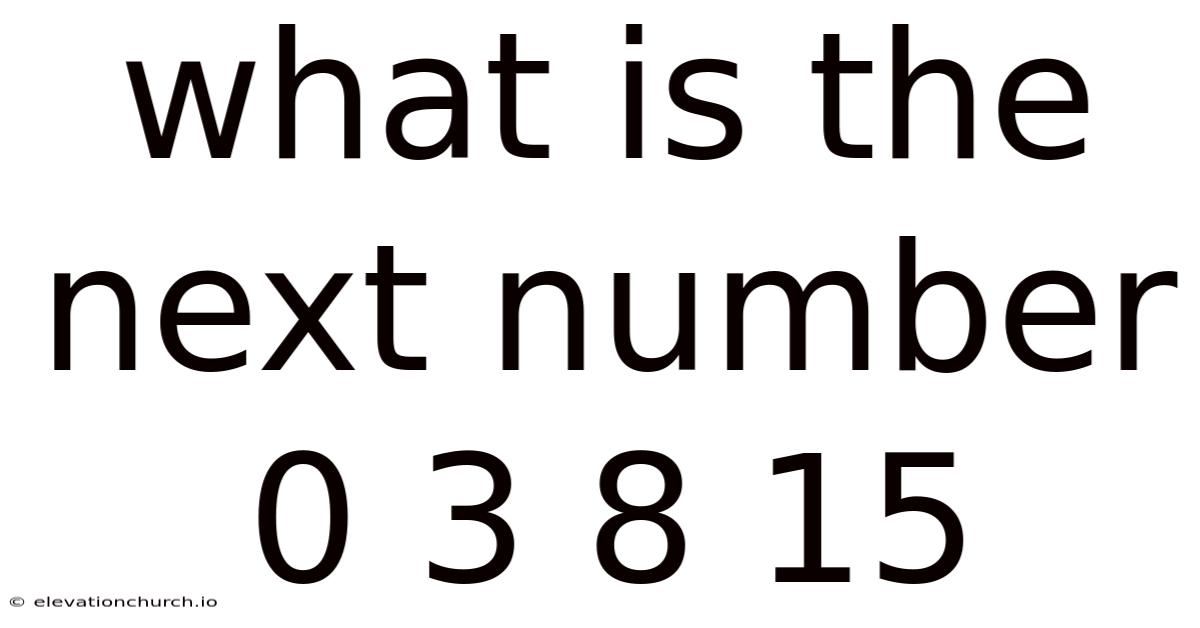
Sequences like 0, 3, 8, 15 capture the imagination precisely because they sit at the intersection of simplicity and discovery. On the surface, the numbers appear random, but beneath lies a consistent, elegant rule that has guided countless learners toward deeper mathematical insight. Consider this: the question “what is the next number 0 3 8 15” serves as a gateway to understanding how patterns function, how algebra can describe change, and how a systematic approach transforms confusion into clarity. In educational settings, tackling such puzzles builds number sense, encourages logical reasoning, and prepares students for more advanced topics in algebra and calculus. This article explores the sequence step by step, uncovers the governing formula, and demonstrates practical strategies for identifying similar patterns in the future.
Some disagree here. Fair enough.
Identifying the Pattern The most immediate clue lies in the gaps between consecutive terms. Calculating the differences:
- 3 − 0 = 3
- 8 − 3 = 5
- 15 − 8 = 7
The differences themselves—3, 5, 7—form an arithmetic sequence increasing by 2 each time. This steady
increase signals that the original sequence is quadratic in nature. But when first differences grow linearly, the generating function takes the form $an^2 + bn + c$. Recognizing this relationship allows us to move from observation to algebraic certainty.
Deriving the Explicit Formula Assuming the first term corresponds to $n=1$, we set up a system of equations using the known values:
- For $n=1$: $a(1)^2 + b(1) + c = 0 \implies a + b + c = 0$
- For $n=2$: $a(2)^2 + b(2) + c = 3 \implies 4a + 2b + c = 3$
- For $n=3$: $a(3)^2 + b(3) + c = 8 \implies 9a + 3b + c = 8$
Subtracting the first equation from the second yields $3a + b = 3$. Solving this pair gives $a = 1$ and $b = 0$. Subtracting the second from the third yields $5a + b = 5$. Substituting back into the first equation gives $c = -1$. The explicit rule is therefore $n^2 - 1$ That alone is useful..
This formula reveals a beautiful structural identity: each term is exactly one less than a perfect square.
- $1^2 - 1 = 0$
- $2^2 - 1 = 3$
- $3^2 - 1 = 8$
- $4^2 - 1 = 15$
Predicting the Next Term With the rule $n^2 - 1$ established, the fifth term ($n=5$) is calculated instantly: $5^2 - 1 = 25 - 1 = 24$
The sequence continues: 0, 3, 8, 15, 24, 35, 48, and so on. The method of finite differences confirms this; the next first difference would be $7 + 2 = 9$, and $15 + 9 = 24$.
Strategies for Future Pattern Recognition This example illustrates a universal toolkit for sequence analysis:
- Compute successive differences until a constant row appears. A constant first difference implies a linear rule; a constant second difference implies a quadratic rule; a constant third difference implies a cubic rule.
- Check against known sequences: squares ($n^2$), cubes ($n^3$), triangular numbers ($\frac{n(n+1)}{2}$), primes, or factorials. The sequence 0, 3, 8, 15 is a classic "near-miss" of the square numbers.
- Shift the index: If $n=1$ produces awkward fractions, try defining the first term as $n=0$ or $n=2$ to simplify the algebra.
- Look for recursive definitions: Here, $a_n = a_{n-1} + (2n-1)$ with $a_1=0$ describes the sequence perfectly without requiring the explicit quadratic form.
Conclusion The journey from the raw data "0, 3, 8, 15" to the closed-form expression $n^2 - 1$ encapsulates the essence of mathematical thinking: observe, hypothesize, verify, and generalize. What begins as a puzzle about the "next number" evolves into a lesson on polynomial growth, the method of finite differences, and the deep connection between discrete sequences and continuous functions. Mastering this workflow empowers learners to dissect far more complex patterns—whether in financial modeling, algorithmic complexity, or the natural sciences—turning the unknown into the understood, one difference at a time Simple, but easy to overlook..
