Of course. Here is a complete, in-depth article on the topic.
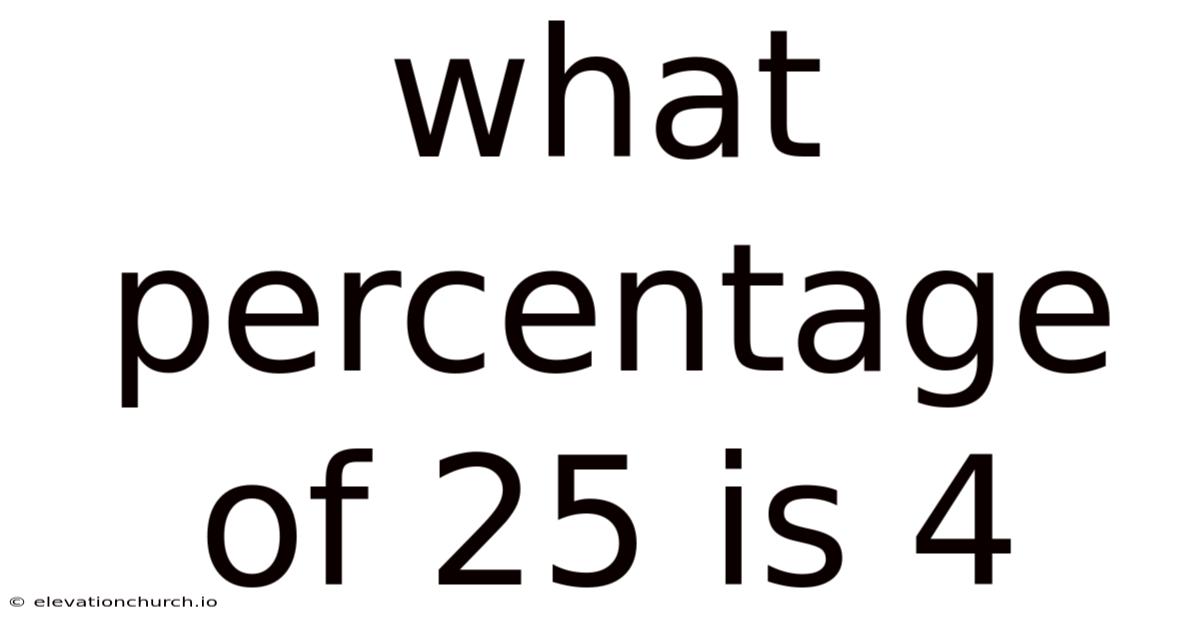
What Percentage of 25 is 4? A Deep Dive into Percentages
The question "What percentage of 25 is 4?In practice, " might seem simple on the surface, but it opens the door to a fundamental mathematical concept that we encounter daily: percentages. Understanding how to calculate percentages is not just an academic exercise; it's a practical skill used in everything from shopping discounts and financial reports to cooking recipes and scientific data analysis. In this article, we will not only solve the specific problem of finding what percentage 4 is of 25 but also explore the core principles, practical applications, and common pitfalls associated with percentage calculations Less friction, more output..
The Core Concept: What is a Percentage?
Before we tackle the numbers, it's crucial to understand what a percentage represents. Here's the thing — the word "percentage" comes from the Latin per centum, meaning "by the hundred. " Because of this, a percentage is simply a way of expressing a number as a fraction of 100. The symbol "%" is a shorthand for "divided by 100" or "out of 100.
As an example, 50% means 50 out of 100, which is equivalent to the fraction 50/100 or the decimal 0.50. This standardized form makes it easy to compare different proportions, regardless of their original size.
Breaking Down the Problem: "What Percentage of 25 is 4?"
This type of question follows a standard structure: "What percentage of [Whole] is [Part]?" In our case:
- Whole (Base): 25
- Part: 4
- Percentage: The unknown value we are trying to find (let's call it P).
The fundamental formula for solving any percentage problem is:
(Part / Whole) × 100 = Percentage
This formula makes intuitive sense. That's why we are asking two questions:
- What fraction is the Part of the Whole? (Part / Whole)
- How do we convert that fraction into a percentage, which is a value out of 100?
Step-by-Step Calculation
Now, let's apply the formula to our specific numbers.
-
Identify the Part and the Whole:
- Part = 4
- Whole = 25
-
Divide the Part by the Whole:
- 4 ÷ 25 = 0.16
- This calculation tells us that 4 is sixteen-hundredths of 25. In fraction form, this is 4/25.
-
Multiply the Result by 100 to Convert to a Percentage:
- 0.16 × 100 = 16
- This step shifts the decimal point two places to the right, effectively scaling the fraction to a value out of 100.
That's why, 4 is 16% of 25.
Verifying the Answer
It's always good practice to check our work. If 4 is 16% of 25, then 16% of 25 should equal 4. Let's test this Less friction, more output..
To find 16% of 25, we multiply 25 by the decimal form of the percentage (0.16): 25 × 0.16 = 4
The calculation confirms that our answer is correct. This reverse check is a powerful tool for ensuring accuracy in percentage problems That's the part that actually makes a difference..
Alternative Methods and Visualizations
While the formula is the most straightforward method, understanding different approaches can deepen your comprehension.
Method 1: Using Fractions We can express the problem as a fraction and then convert it to a percentage.
- The fraction is 4/25.
- To convert a fraction to a percentage, we multiply it by 100/1: (4/25) × (100/1) = (4 × 100) / 25 = 400 / 25 = 16. This method avoids decimals entirely and can be useful for those who are more comfortable with fractions.
Method 2: The "Out of 100" Strategy The goal of a percentage is to express a value "out of 100." We can manipulate the fraction 4/25 to have a denominator of 100 That alone is useful..
- We ask: "What number, when divided by 100, is equivalent to 4/25?"
- To change the denominator from 25 to 100, we multiply by 4 (since 25 × 4 = 100).
- To keep the fraction equivalent, we must also multiply the numerator by 4: 4 × 4 = 16.
- This gives us the new, equivalent fraction: 16/100.
- By definition, 16/100 is 16%. This method provides a very clear, visual understanding of why the answer is 16.
Visualizing with a Bar Model Imagine a bar representing the whole value of 25. We can divide this bar into 25 equal parts. The "part" we are interested in is 4 of those parts. If we want to see this as a percentage, we need to group the parts into sets of 100. Since our bar only has 25 parts, we can imagine stacking four of these identical bars to get a total of 100 parts. In this larger group, our original 4 parts would now represent 16 parts out of the total 100, visually confirming the 16% result.
Common Percentage Problem Types and How to Solve Them
The "Part/Whole/Percentage" triangle is the key to solving virtually all percentage problems. The three elements are interconnected:
- Percentage = (Part / Whole) × 100
- Part = (Percentage / 100) × Whole
- Whole = (Part / Percentage) × 100
Let's see how this applies to other common scenarios:
-
Finding the Part: "What is 20% of 50?"
- Whole = 50, Percentage = 20
- Part = (20 / 100) × 50 = 0.20 × 50 = 10
-
Finding the Whole: "15 is 30% of what number?"
- Part = 15, Percentage = 30
- Whole = (15 / 30) × 100 = 0.5 × 100 = 50
-
Finding the Percentage (Our Original Problem): "What percentage of 80 is 20?"
- Part = 20, Whole = 80
- Percentage = (20 / 80) × 100 = 0.25 × 100 = 25%
Real-World Applications
The skill of calculating percentages is indispensable. Consider these examples:
- Shopping: An item originally priced at $25 is on sale for $4 off. What is the percentage discount? This is exactly our problem: the discount ($4) is the part, and the original price ($25) is the whole. The discount is 16%.
Beyond the retail discount, percentages are essential in finance. Still, 5 % means that for every $100 saved, you earn $3. Here's the thing — when you compare interest rates on savings accounts or loans, you are comparing percentages. 50 in a year. Here's one way to look at it: an annual interest rate of 3.Recognizing this helps you choose the most advantageous financial products.
Honestly, this part trips people up more than it should And that's really what it comes down to..
In education, percentages are used to express grades. If a student answers
