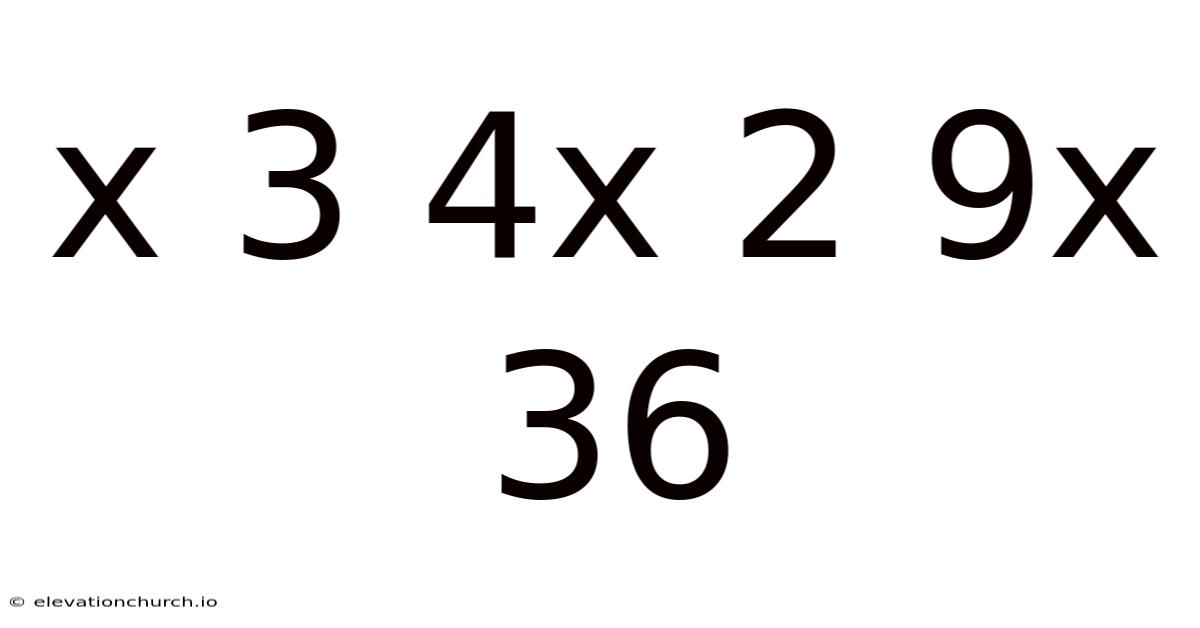
Of course. Here is a complete, in-depth educational article about solving the polynomial equation x³ + 4x² + 9x + 36 = 0.
Cracking the Code: A Step-by-Step Guide to Solving the Polynomial x³ + 4x² + 9x + 36 = 0
Encountering a cubic equation like x³ + 4x² + 9x + 36 = 0 can seem daunting at first glance. Even so, unlike simpler linear or quadratic equations, cubics don't have a one-size-fits-all formula that is as straightforward. On the flip side, they are far from unsolvable mysteries. So this article will demystify the process, providing a clear, step-by-step guide to finding the solutions, or "roots," of this specific polynomial. We will explore a powerful technique called "factoring by grouping," verify our results, and even touch upon what the solutions mean graphically. By the end, you will not only know the answer but also understand the why behind each step, empowering you to tackle similar problems with confidence.
The Goal: Finding the Roots
The fundamental objective when presented with an equation like x³ + 4x² + 9x + 36 = 0 is to find the value(s) of x that make the equation true. These values are called the roots or zeros of the polynomial. For a cubic equation, which is a polynomial of degree 3, we can expect up to three real roots (or one real root and two complex ones). Our mission is to find them.
Step 1: The Strategy – Factoring by Grouping
The most efficient method for this particular equation is factoring by grouping. This technique is particularly useful when a polynomial has four terms, as ours does: x³, 4x², 9x, and 36. The idea is to group the terms into pairs, factor out the greatest common factor (GCF) from each pair, and hopefully, reveal a common binomial factor That alone is useful..
Let's apply this to our equation:
x³ + 4x² + 9x + 36 = 0
We group the first two terms together and the last two terms together:
(x³ + 4x²) + (9x + 36) = 0
Step 2: Factoring Each Group
Now, we factor out the GCF from each group But it adds up..
- From the first group (x³ + 4x²): The GCF is x². Factoring it out gives us: x²(x + 4)
- From the second group (9x + 36): The GCF is 9. Factoring it out gives us: 9(x + 4)
Substituting these back into our equation, we get:
x²(x + 4) + 9(x + 4) = 0
Step 3: Extracting the Common Binomial Factor
This is the crucial "aha!" moment. Look at the expression: x²(x + 4) + 9(x + 4). Notice that (x + 4) is a common factor in both terms. We can think of (x + 4) as a single unit. So, we factor it out, just like we did with the GCF.
This gives us:
(x + 4)(x² + 9) = 0
And just like that, we have successfully factored our cubic polynomial into the product of a linear factor (x + 4) and a quadratic factor (x² + 9).
Step 4: Solving for the Roots Using the Zero Product Property
Now we have a much simpler equation: (x + 4)(x² + 9) = 0. The Zero Product Property states that if the product of multiple factors is zero, then at least one of the factors must itself be zero. This allows us to set each factor equal to zero and solve.
Case 1: The Linear Factor x + 4 = 0 Subtracting 4 from both sides, we get: x = -4 This is our first, and most straightforward, real root.
Case 2: The Quadratic Factor x² + 9 = 0 To solve for x, we first isolate x²: x² = -9 Now, we take the square root of both sides. Remember that the square root of a negative number involves the imaginary unit i, where i² = -1. x = ±√(-9) x = ±√(9 * -1) x = ±3√(-1) x = ±3i This gives us two complex roots: x = 3i and x = -3i That's the whole idea..
The Complete Solution Set
So, the three roots of the equation x³ + 4x² + 9x + 36 = 0 are: x = -4, x = 3i, and x = -3i.
Verification: Checking Our Work
It's always good practice to verify our solutions. We can do this by plugging each root back into the original polynomial.
-
For x = -4: (-4)³ + 4(-4)² + 9(-4) + 36 = -64 + 4(16) - 36 + 36 = -64 + 64 - 36 + 36 = 0. (Correct)
-
For x = 3i: (3i)³ + 4(3i)² + 9(3i) + 36 = 27i³ + 4(9i²) + 27i + 36 Since i³ = i² * i = -1 * i = -i, and i² = -1: = 27(-i) + 4(9 * -1) + 27i + 36 = -27i - 36 + 27i + 36 = 0. (Correct)
-
For x = -3i: A similar calculation will also yield 0, confirming it is a valid root.
A Glimpse into the Graphical Meaning
The roots of a polynomial correspond to the points where its graph crosses or touches the x-axis (y=0). For our equation:
- The real root x = -4 means the graph of y = x³ + 4x² + 9x + 36 will cross the x-axis at the point (-4, 0). Worth adding: this tells us the graph only intersects the x-axis once. * The complex roots x = ±3i do not correspond to points on the real xy-plane. A cubic polynomial will always have at least one real root, which aligns with what we found.
Alternative Approach: The Rational Root Theorem
While factoring by grouping was efficient here, it's not always obvious. An alternative method is the Rational Root Theorem. This theorem states that any rational root of a polynomial with integer coefficients must be of the form ±p/q, where p is a factor of the constant term (36) and q is a factor of the leading coefficient (1) Most people skip this — try not to..
The
possible rational roots are simply the integer factors of 36: ±1, ±2, ±3, ±4, ±6, ±9, ±12, ±18, and ±36.
Testing these values by substitution or synthetic division reveals that x = -4 is a root:
(-4)³ + 4(-4)² + 9(-4) + 36 = -64 + 64 - 36 + 36 = 0.
Once one root is identified, we can divide the original polynomial by (x + 4) using synthetic division:
-4 | 1 4 9 36
| -4 0 -36 |
|---|
1 0 9 0
The result is the quadratic x² + 0x + 9, or simply x² + 9. Setting this equal to zero gives x² = -9, leading once again to x = ±3i.
Comparing the Methods
Factoring by grouping works beautifully when the polynomial is structured to allow it, as it was here. Here's the thing — the Rational Root Theorem is more systematic and reliable when grouping isn't immediately apparent, though it can involve testing several candidates. Both approaches confirm the same solution set and reinforce the Fundamental Theorem of Algebra, which guarantees that a cubic polynomial has exactly three roots in the complex number system (counting multiplicity).
Conclusion
By factoring x³ + 4x² + 9x + 36 = 0 into (x + 4)(x² + 9) = 0, we determined that the equation has one real root, x = -4, and two complex conjugate roots, x = 3i and x = -3i. In practice, while the graph intersects the x-axis only once at (-4, 0), the complete solution set in the complex plane contains all three roots. Whether you use factoring by grouping or the Rational Root Theorem, the process illustrates how higher-degree polynomials can be broken down into manageable linear and quadratic factors, revealing both real and imaginary solutions.
Short version: it depends. Long version — keep reading And that's really what it comes down to..
